Avoided Emissions and Comparative Carbon Impact Assessments
SuSciCo has supported companies and sustainability initiatives in quantifying greenhouse gas emission avoidance associated with recycling, diversion from landfill and lower-impact material choices.
Projects have included work for Coffex Coffee, Zero Waste Earth Store, BDO, Medalab, and others.

Scope Overview
Many companies implement recycling, circularity or material-reduction initiatives but cannot clearly explain their carbon impact.
SuSciCo helps translate these activities into documented emissions information by defining the assessment boundary, reviewing available activity data, and comparing relevant baseline and project scenarios.
Each assessment is adapted to the purpose of the project, the available evidence and the type of emission-reduction claim being considered.
Areas of Support
Emission Avoidance from Recycling and Diversion
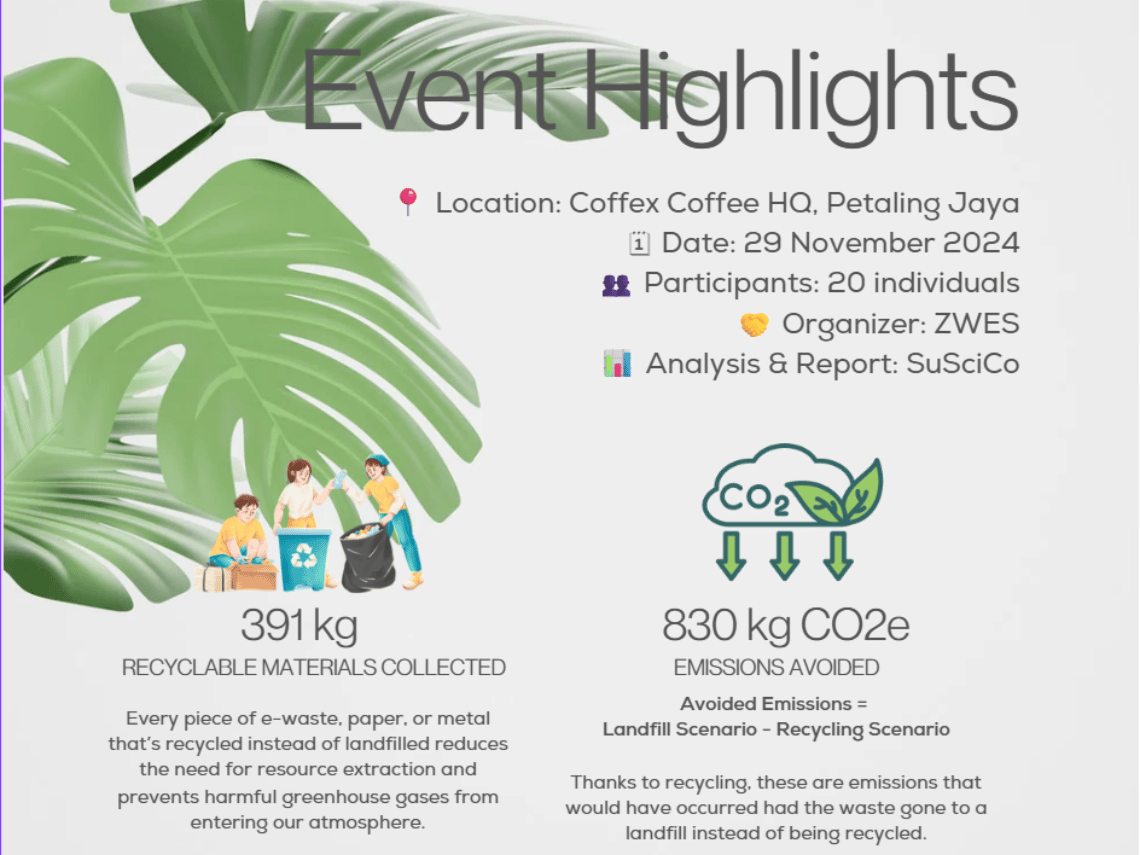
For recycling and collection initiatives, SuSciCo assessed the greenhouse gas implications of diverting materials from disposal and directing them toward recycling or recovery routes.
The resulting reports provided a clearer basis for communicating the estimated carbon impact of the initiative.
Baseline and Project Scenario Assessment
The work included comparing the defined baseline scenario with the recycling, recovery or alternative-material scenario.
This helped organisations understand where emission reductions may arise and which assumptions materially influence the result.
Comparative Product and Material Assessment
For Medalab, SuSciCo compared bamboo medals with conventional zinc-alloy medals across relevant life-cycle stages.
The assessment provided evidence on how material selection and product design may influence greenhouse gas emissions and broader environmental performance.
Project Value
These engagements helped organisations develop a more structured basis for:
- Quantifying estimated emission avoidance
- Supporting climate and ESG disclosures
- Communicating recycling and circularity outcomes
- Comparing lower-carbon materials and products
- Strengthening the evidence behind environmental claims
The projects demonstrate SuSciCo’s ability to connect practical sustainability initiatives with measurable and documented carbon outcomes.
Do You Need to Quantify the Emission Avoidance & Reduction Impact of an Initiative?
SuSciCo supports companies with emission-avoidance and reduction assessments, recycling carbon-impact reports, comparative product studies and related technical documentation.
Can SuSciCo calculate the emission avoidance from a recycling initiative?
SuSciCo can compare a defined baseline scenario with the recycling or recovery scenario using available activity data, suitable emission factors and clearly documented assumptions.
Can SuSciCo compare the carbon impact of alternative products or materials?
Yes. SuSciCo can assess alternative products or materials where the functional use, system boundaries and available data support a reasonable comparison. Key assumptions and limitations are documented clearly.
What evidence is needed to support an emission-reduction claim?
Typical evidence includes material quantities, collection or processing records, treatment routes, baseline assumptions and supporting operational documents. SuSciCo can identify gaps before the assessment begins.