
- 25/05/2026
- Posted by: Ildar Usmanov
- Categories: Carbon Footprint, Supplier/Exporter
Why PCF Is Not Just a Number
Many companies first see a Product Carbon Footprint as a calculation exercise.
A customer asks for product-level emissions information. A buyer sends a carbon-related questionnaire. A tender includes a carbon data request. A sustainability team needs product carbon information for reporting or supplier engagement.
At that point, the natural question is:
How do we calculate the Product Carbon Footprint?
That is understandable. But it is not the only question manufacturers should ask.
A better question is:
Can we explain the Product Carbon Footprint after it is calculated?
A Product Carbon Footprint, or PCF, is not just a figure expressed in kg CO₂e per product unit. Once it is shared with a buyer, used in a tender, included in a report, submitted for review, or prepared for verification, it becomes a product-related claim.
That claim needs support
A PCF result should not only look complete in a final PDF.
If it is shared with a buyer, used in a tender, included in a report or prepared for review, the company should be able to explain how the result was developed and what it represents.
This is where many manufacturers underestimate the work involved.
The challenge usually starts before calculation
The issue is not always that the company has no data.
In many cases, production, procurement, finance, logistics, maintenance and sustainability teams already hold information that may be relevant to the PCF.
The challenge is that this information was not originally collected for product carbon accounting.
Before a PCF can be calculated properly, the product, process, boundary and data responsibilities need to be clear enough for the result to be explained later.
Why this matters for manufacturers
For manufacturers, PCF work must reflect production reality.
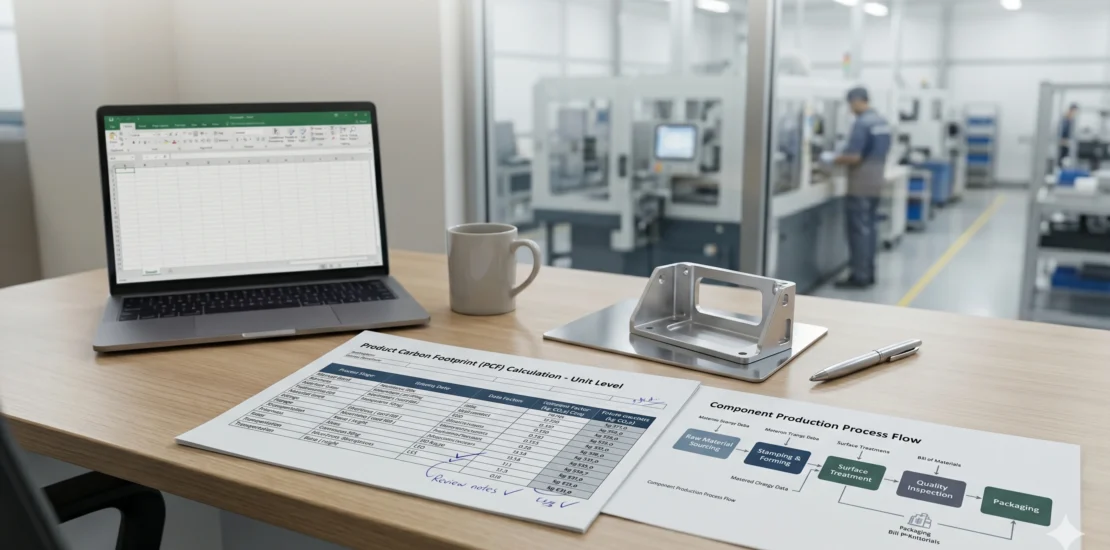
The assessment should be connected to how the product is actually made, not only to a generic calculation template.
This matters because buyer-facing PCF information is rarely judged only by the final number. It may also raise questions about whether the result reflects the product, the process and the company’s data clearly enough.
A PCF that looks complete on paper can still create difficulty if the company cannot explain it confidently when questions arise.
Assessment alone may not be enough
A PCF assessment can provide the result, workbook and report structure.
But the quality of the work still depends on the company’s internal data owners.
For companies facing an immediate buyer request, assessment may be the first priority.
For companies that are not yet ready, PCF readiness training may be a better starting point.
For manufacturers expecting repeated product carbon requests, assessment and training can work together so the company is not starting from zero each time a new product or buyer request appears.
The real value of PCF work
The value of PCF work is not only the final number.
A useful PCF helps the company respond more clearly to buyer questions, avoid unsupported product carbon claims and build a stronger foundation for future product-level carbon work.
For Malaysian manufacturers, the stronger response is not simply the lowest carbon number. It is the number the company can explain responsibly.
A Product Carbon Footprint is a structured claim about a product, and it needs scope, evidence and people who can stand behind it.
How SuSciCo can support
SuSciCo supports manufacturers through Product Carbon Footprint assessment, PCF assessment readiness training, or a combined assessment-and-training approach.
We help companies structure PCF work so the result can be reviewed, explained and supported by appropriate documentation.
SuSciCo does not certify product carbon claims, act as a verification body, guarantee buyer acceptance, or guarantee verification outcomes.
Our role is to support preparation, documentation, internal readiness and responsible communication within clear professional boundaries.
If your company needs a Product Carbon Footprint for a buyer request, tender, reporting purpose or future review, the next step is to discuss whether assessment, readiness training, or a combined approach is the right starting point.
how can we help you?
Ready to align profitability with impactful ESG strategies? Contact us today to discuss how we can help your business thrive sustainably.
The training was highly practical, relevant and well-structured. What we found particularly valuable was the hands-on approach to identifying relevant Scope 3 categories, mapping data sources and owners and working through different calculation methods. Mr. Ildar demonstrated strong technical knowledge and was very effective in translating the requirements into practical steps that are relevant to our business operations.

“SuSciCo delivered a series of practical and well-structured ESG training sessions tailored to FJM’s needs. Their strong technical knowledge, clear guidance, and professional approach helped our team better understand and apply key sustainability concepts. We would be pleased to recommend SuSciCo for practical ESG training and advisory support.”

SuSciCo conducted the Life Cycle Assessment in a smooth and efficient manner, making the entire process clear and straightforward for us. The final report was highly informative and provided valuable insights for our work. We truly appreciated their responsiveness, professionalism, and commitment to delivering quality results.

“At Zero Waste Earth Store, we are incredibly grateful for SuSciCo’s exceptional GHG reporting services. Their expertise, professionalism, and attention to detail helped us accurately measure and communicate the environmental impact of our recycling efforts. We highly recommend SuSciCo to any organisation seeking reliable sustainability support.”
